
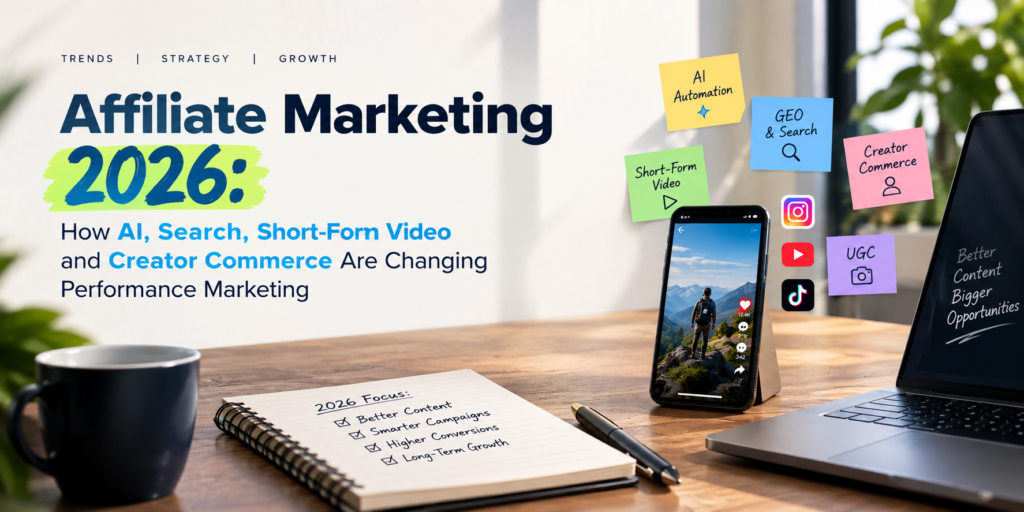
Affiliate Marketing Trends 2026: AI, Search & Social
Every few years, affiliate marketing goes through a phase that reshuffles who wins and who gets left behind. 2026 feels like one of those years. Between AI tools rewriting how content gets made, search engines answering questions before anyone clicks a link, and creators becoming a legitimate traffic channel of their own, the playbook that worked in 2022 is starting to show its age.
The $20 Billion Number, and What's Actually Behind It
According to a PRNewswire report on the state of the industry, global affiliate marketing spend has reportedly climbed to around $20 billion, with AI-powered workflow automation and short-form video commerce cited as major drivers. Admitad’s 2026 trends analysis points in a similar direction, tying growth to faster content cycles and the rise of social-first affiliate traffic.
I wouldn’t treat that figure as gospel—spend estimates in this industry vary a lot depending on who’s counting and what counts as “affiliate.” But directionally, it lines up with what a lot of people in the space have been watching happen: budgets moving away from purely search-driven campaigns and toward a mix of AI-assisted content, video, and creator partnerships.
How AI Is Changing Affiliate Marketing Workflows
The supplied research suggests roughly 80% of marketers now use AI somewhere in their content creation process. That’s a big shift from a few years ago, when AI tools in affiliate marketing were mostly experimental.
In practice, this shows up in keyword research, first-draft content, product comparison tables, and even email sequences. LLM hasn’t replaced the strategy layer—it’s replaced a lot of the grunt work that used to eat up a publisher’s week.
GEO: When Search Stops Sending Clicks
One of the bigger structural shifts is what’s often called GEO—generative engine optimization, or optimizing for automated search summaries rather than just traditional blue-link rankings.
Marketers are adapting content strategies specifically for automated search overviews and generative search results, per the cited research. That matters because when a machine-generated overview answers a question directly on the results page, the affiliate site that would have earned that click may never get visited at all.
This doesn’t mean SEO is dead. It means the target has moved. Getting cited inside an AI answer—through clear, well-structured, authoritative content—is becoming its own discipline, distinct from ranking for a blue link.
Automated Bidding and Real-Time Optimization
Automated bidding systems are increasingly handling keyword bidding and real-time campaign adjustments, according to the research behind this piece. That’s freeing up media buyers from constant manual bid tweaking.
From what I’ve observed in how these systems tend to behave, automation is only as good as the signal it’s optimizing against. If conversion tracking is inconsistent—missing postback URLs, delayed attribution, duplicate conversions—an automated system will confidently optimize toward the wrong thing, just faster than a human would have.
Faster Content, for Better or Worse
AI is compressing content production timelines, with some teams reportedly moving toward 30-day content sprints instead of the quarter-long production cycles that used to be normal.
That speed is genuinely useful for time-sensitive campaigns—seasonal promotions, product launches, and trending topics. But speed and quality aren’t the same axis. One pattern I’ve noticed across the industry is that faster production tends to widen the gap between teams that use AI as a drafting tool and teams that use it as a publishing tool. The first group edits, fact-checks, and adds real expertise. The second group ships whatever the model produces.
Creator Commerce: Influencers as a Traffic Channel
Creator commerce—blending influencer recommendations directly with affiliate links—is one of the more interesting convergences happening right now. The supplied research reports that creator-led affiliate activity can increase sales by as much as 46%, though as with most influencer statistics, that number will vary heavily by niche, creator trust, and audience fit.
What’s clear directionally is that affiliates who once relied purely on blog content are increasingly partnering with or becoming creators themselves.
Reels, Shorts, and the Vertical Video Shift
Instagram Reels and YouTube Shorts are reported to achieve 3–5x higher click-through rates compared to static posts, based on the cited data. That’s a meaningful gap, and it tracks with the broader platform shift toward short, vertical, algorithm-fed video.
The affiliates adapting fastest aren’t necessarily the most polished — they’re the ones treating short-form video as a discovery channel rather than a direct-response one, then pointing viewers toward more detailed content or a link in bio.
UGC: Why “Authentic” Still Converts
User-generated content is reported to achieve roughly 4x higher click-through rates at lower production costs, according to the supplied data. That’s consistent with something most performance marketers have suspected for a while: audiences are increasingly skeptical of anything that looks like a polished ad.
Traditional vs. AI-Driven Affiliate Marketing
| Traditional Affiliate Marketing | AI-Driven Affiliate Marketing |
|---|---|
| Manual research | AI-assisted research |
| Manual campaign optimization | Automated optimization |
| Long content production cycles | Faster content workflows |
| Search-focused traffic | Search + AI + social + video |
| Static promotional creatives | Dynamic/UGC/creator content |
| Limited data analysis | Real-time performance analysis |
What We Have Noticed From the Data
Reading through these numbers together, a few patterns stand out. Higher CTR on Reels and Shorts doesn’t automatically mean higher conversion rate—attention and purchase intent are different things, and the research cited here speaks to click behavior, not necessarily down-funnel results.
Faster content velocity is a double-edged sword: it can improve search coverage, but it can also flood a niche with thin content, which may hurt overall traffic quality even as volume increases. And automated bidding can genuinely improve cost efficiency—but only when the underlying tracking data is clean.
An Experienced Marketer’s View
A few realities tend to hold up regardless of what tools are trendy: more traffic doesn’t automatically mean more conversions. Machine Learning can increase content volume, but it can just as easily increase the volume of low-quality, forgettable content. Short-form video generates attention, but attention isn’t the same as intent to buy. Automated bidding can optimize a campaign quickly, but bad tracking will produce confidently wrong optimization. And a smaller amount of high-quality, high-intent traffic will often outperform a much larger pool of casual clicks.
The Uncomfortable Truth About AI in Affiliate Marketing
Here’s the part that doesn’t get said enough: Artificial intelligence may not make every affiliate marketer more successful. It may simply make average marketing cheaper and faster to produce.
If everyone has access to the same AI tools for research, drafting, and optimization, the baseline quality of competing content rises across the board—which means competition may intensify rather than ease off. The advantage shifts toward whoever still brings something Artificial Intelligence can’t fully replicate: real expertise, original testing, genuine audience trust, and editorial judgment about what’s actually worth publishing.
What We Have Noticed From the Data
Affiliates need to treat artificial intelligence as a first-draft tool, not a finished product, and lean harder into formats—video, UGC, creator partnerships—that are harder to commoditize.
Publishers should focus on depth and originality in content that’s genuinely useful, since generic AI content is becoming a commodity.
Advertisers need to audit tracking infrastructure before leaning on automated bidding, since bad data plus automation equals fast, expensive mistakes.
Affiliate networks are likely to play a bigger role in verifying traffic quality and creator authenticity as more affiliate activity moves off traditional search and onto social and video platforms.
Affiliate marketing in 2026 isn’t being replaced by LLM—it’s being reorganized around it. Search is fragmenting into traditional and generative results, video is becoming a real traffic source rather than a side channel, and the marketers who win will likely be the ones who use machine learning to move faster without losing the judgment that made good affiliate marketing work in the first place.